
Home Addition vs. Moving in Austin: How to Make the Call
At some point, your house can stop fitting your life. Maybe you have a third kid and the bedrooms don’t work anymore. Maybe you’re working from home and there’s nowhere to close a door. Maybe your in-laws are moving closer and you need space that’s theirs without being a separate property. In most cities, the answer to “we need more space” is “start shopping.” In Austin, it’s
more complicated than that. You know what it took to get into this neighborhood. You’ve watched what comparable homes sell for, and what they’re actually worth. You understand that trading your current mortgage rate for a new one could cost you more
per month than a construction loan. And if you’ve got kids in school, you might not want to leave.
So the question isn’t just “can we afford to move?” It’s “which option actually makes sense for our situation?”
We’ve had this conversation with hundreds of Austin homeowners. Here’s the framework we walk through.
The Real Cost of Moving in Austin
Most people calculate the cost of moving as the list price of the new house minus sale price of the current house. That math leaves out a lot.
Agent commissions: Selling your home means paying agent fees on both sides of the transaction.
Closing costs on the purchase: Buying a new home comes with its own closing costs on top of the purchase price.
Your mortgage rate: If you bought or refinanced before 2022, you likely have a rate that no longer exists. Moving means giving that low rate up. On a significant loan balance, the difference in monthly payment between your current rate and today’s market rate can be substantial, sometimes more than a construction loan payment on an addition would cost.
Moving costs, overlap, and disruption: Storage, temporary housing if there’s a gap, two moves, time off work, and the mental load of a full household move with kids should all be taken into consideration as well.
The school district question: In Austin, school district boundaries don’t always follow neighborhood lines. Moving across town, or even across a few streets, can mean a school change. That’s a calculated decision, even if it doesn’t show up on a spreadsheet.
Add it all together and the real cost of moving is often significantly higher than the sticker price difference between your current home and the next one.
When a Home Addition Makes More Sense
An addition wins when the problem is the house, not the location.
You love where you are. Your neighborhood, your commute, your kids’ school, your neighbors, the coffee shop you walk to on Saturdays. None of that moves with you. If the only thing wrong with your situation is that the house is too small, building a home addition is usually cheaper and less stress than moving.
Your lot can support it. Austin’s land development code sets rules for how much of your lot can be covered by structures. Before you fall in love with a floor plan, confirm with the city that your lot has room for it. A good builder does this in the first walkthrough…not after you’ve paid for design work.
The bones are good. If you have a solid foundation, a well-maintained structure, and a layout that works with what you want to add, a home addition can make sense. Older Austin homes, the 1960s and 70s builds you find in Lost Creek, Hyde Park, Rosedale, and Barton Hills, were often built well. They can carry a second story if the foundation is sound and the framing is upgraded correctly.
The layout problem is solvable. Adding square footage doesn’t fix a bad layout. If the issue is that the rooms are in the wrong places, an addition needs to be paired with reconfiguration, or the new space won’t feel right. We assess this in pre-construction before anything gets permitted.
You’re not trying to manufacture equity. An addition done well adds real value to a home. But building primarily to capture resale value is a riskier bet than building because the space genuinely improves your life. Build for the life you’re living now.
When Moving Makes More Sense
At Skelly Build, we will tell you when moving is the right answer, and it’s often under one of the below circumstances:
The problem is the neighborhood, not the house. School district, commute, proximity to family, safety, and noise do not get solved by adding a bedroom. If the location isn’t working, no amount of construction can fix it.
The lot can’t support what you need. Some Austin lots are already at or near their impervious cover limit. Some have heritage trees that restrict where you can build. Some are shaped in ways that make a meaningful addition structurally impractical or prohibitively expensive. We will assess your lot and tell you this upfront, before you spend a bunch of money on design services.
The foundation or structure has serious issues. In some cases, building on a compromised foundation can cost more than starting over. If a pre-construction assessment reveals significant structural problems, the economics of an addition can shift dramatically. Again, Skelly Build will be speak directly to you about any serious foundation or structural issues that would impede a successful home addition.
The gap between what you need and what you have is too large. Sometimes what the family actually needs is a home that’s twice the size of what they have — and moving is more practical than building to that scale on an existing lot.
You need to move anyway. Job relocation, family circumstances, or a need for a specific neighborhood you’re not currently in can make the decision easy for you, and an addition would just be a delay.
A Case Study: How It Played Out in Lost Creek
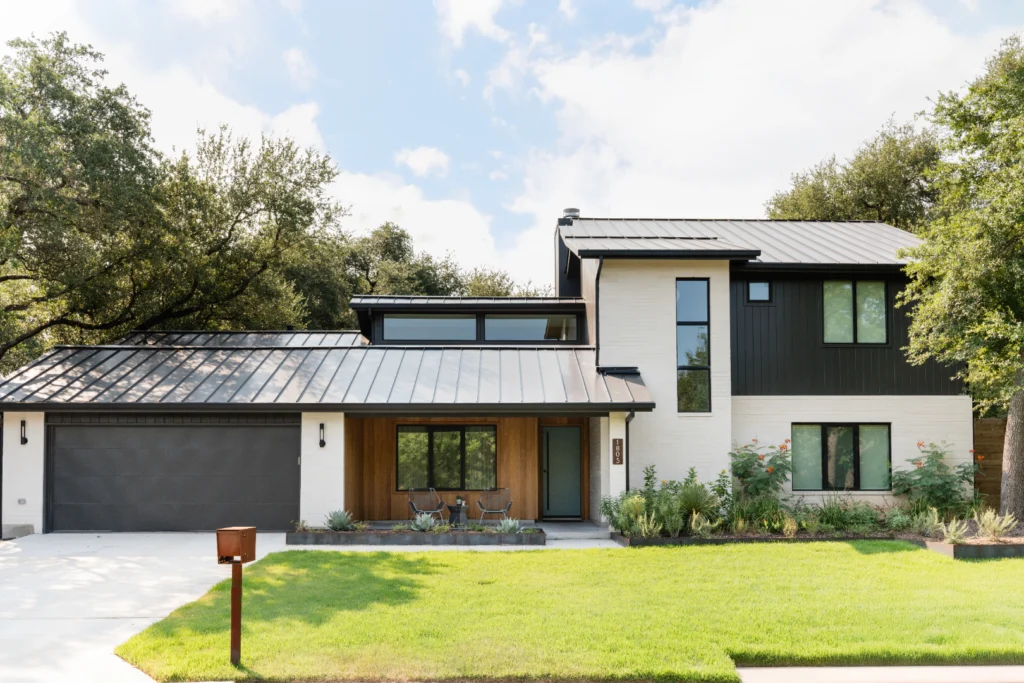
In 2025, a family in Lost Creek came to us with a 1970s single-story home and three growing sons. They’d been in the neighborhood for years and weren’t interested in leaving. The problem was straightforward: not enough bedrooms, not enough space for everyone to have a place to work, study, and fully live.
The answer was a full second story.
We added an upstairs that gave each of the three boys their own bedroom and their own bathroom. The upstairs also gained a retreat, a TV and lounge area, built-in desks for schoolwork and projects; the kind of space that teenagers actually use and parents actually appreciate. Downstairs, we reconfigured the entertaining areas to work better for both casual and formal gatherings.
Every decision in that project was guided by one idea: a space that could grow with the family. Not just what they needed today, but what they’d need in five years when those boys were teenagers. The result was a home that worked…without the transaction costs, school disruption, or mortgage upheaval that moving would have required.
What to Check Before Committing to an Addition
Don’t hire a designer before you know your lot can support the project. These are the things a builder should assess in the first walkthrough:
Impervious cover. Austin limits how much of your lot can be covered by impervious surfaces like structures, driveways, patios. If you’re close to your limit, an addition may require removing impervious cover elsewhere on the lot.
Heritage trees. We love how green Austin is and the protections that the city builds in to keep it that way. Austin’s tree ordinance protects trees above a certain diameter. Construction within the critical root zone of a protected tree requires a permit and arborist review. Some Austin lots have heritage trees that effectively determine where you can and can’t build.
Existing foundation condition. A second-story addition puts new load on an existing foundation. A structural engineer needs to assess whether the current foundation can carry it, and what upgrades are required if not.
Setbacks and zoning. Your lot’s zoning and overlay district determines how close to property lines you can build. A horizontal addition in the wrong direction can run into setback limits quickly.
Utility capacity. Adding significant square footage may require electrical panel upgrades, additional HVAC capacity, or plumbing changes. These show up in a proper pre-construction scope that is considerate of all of these factors.

What We Bring to This Decision
We don’t start by pitching an addition. We start by looking at your lot, your home, and your goals, and telling you what we actually see.
That assessment is part of how we’ve maintained 95% estimate accuracy across 200+ projects. We don’t produce numbers before we’ve done the work of understanding the scope. And scope starts with an honest evaluation of whether an addition is the right move at all.
If it is, we’ll tell you what it takes and what it costs: itemized by trade, not buried in a lump sum. If it isn’t, we’ll tell you that too. We’ve steered more than a few homeowners toward a move when the numbers and the lot didn’t support what they were hoping to build.
We care for people and their spaces. Sometimes that means telling them the truth before they spend money on a decision that will not be beneficial for them in the long run. Still have questions? Below are some common FAQs we process with homeowners when making a home addition decision:
Some Common FAQs
Q: Is a home addition or moving cheaper in Austin?
A: It depends on the specifics, but for most Austin homeowners who bought before 2022 and are in a neighborhood they want to stay in, an addition is frequently the more cost-effective path once you account for the full cost of moving : agent commissions, closing costs, the mortgage rate you’d be giving up, and moving expenses. The calculation is different for everyone. We walk through it in the first consultation.
Q: How much does a home addition cost in Austin?
A: Scope varies too much to give a single number . For example, a 400-square-foot bedroom addition is a fundamentally different project than a full second-story addition. What we can tell you is that our estimates are itemized by trade, and we maintain a 95% estimate accuracy target. You’ll know the real number before you commit to anything.
Q: How long does a home addition take in Austin?
A: A well-scoped addition , including pre-construction, permitting, and construction, typically runs six to twelve months from signed contract to completion. Permitting through the City of Austin is the primary variable outside our control. We build realistic timelines into every project and communicate progress through BuilderTrend 2–3 times per week.
Not Sure Which Way to Go? Start With a Conversation.
The decision to add on or move is one of the biggest a homeowner makes. You don’t need to have it figured out before you call us. We’ve sat across the table from hundreds of Austin families at exactly this crossroads , and we’ll give you an honest read on what your lot can support, what the project would actually cost, and whether it makes sense for your situation.
We care for people and their spaces. That starts long before we break ground. Schedule a Consultation with us today!
Skelly Build | 4361 S Congress Ave #104, Austin, TX 78745 | 512.520.5523 | letsbuild@skellybuild.com